search
tune Filter your result
Filter close
Select filter keyboard_arrow_right
arrow_back Back to filters
Whitefly

28.10.2025Expert Centre blog

Actions against whitefly

Sean Loakes

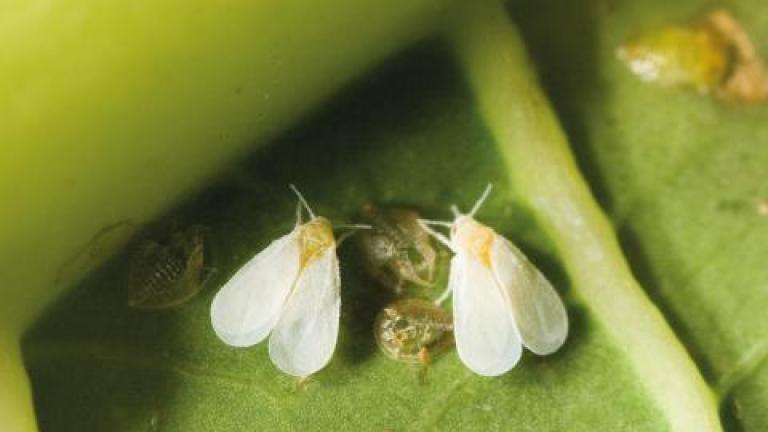
 How do I monitor for whitefly in my crop?What are the key elements in an IPM programme for whitefly?Given the cool and dull conditions that have been a feature of this year’s weather I’m not surprised we haven’t yet heard much about whiteflies in protected crops. As we move into July and hopefully temperatures start to pick up – and especially with poinsettia production getting into full swing – that could quickly change. Infestations can build up rapidly from small populations during warm weather, but they’re hard to spot when numbers are low and causing few symptoms.Glasshouse whitefly (Trialeurodes vaporariorum) is the native species and the most familiar on protected ornamental crops. Cabbage whitefly (Aleyrodes proletella) sometimes migrates in from brassica crops on neighbouring farmland. It can be a problem on some ornamentals, including poinsettia, especially as controlling it with natural enemies can be more of a challenge than for glasshouse whitefly.Growers of poinsettia, and other crops…
thrips

28.10.2025Expert Centre blog

Thrips are tiny creatures

Daniel Lightfoot

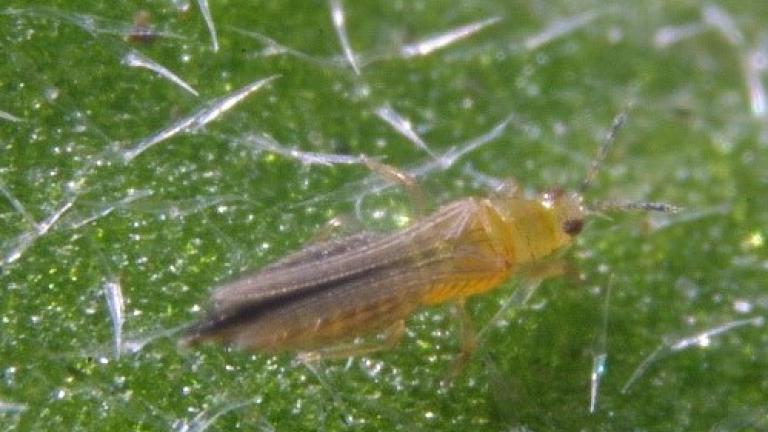
Welcome to our blog! This week as the thunder clouds roll around and autumn begins, that all too familiar tiny bug landed on my arm. The thrip. Slender insects with fringed wings and unique asymmetrical mouthparts. Most are 1mm long or less. Tiny. I wanted to explore the different species and hopefully at the end of my first ornamentals blog you’ll be a little more enlightened.Different species feed mostly on plants by puncturing and sucking up the contents, although a few are predators. Unfortunately for you and for us, we know these insects well. They can destroy healthy crops in a frighteningly short amount of time. With more than 6,000 species, some are really important to understand so we can control the little blighters.Symptoms of thrips in your cropAdults are mainly flower-feeders but will also feed on stems and leaves of plants as well (greedy). Damage can show up in a number of ways:Discolouration and scarring of open blooms and petalsDeformation of buds and flower headsPimpling on some…
Plant spraying

28.10.2025Expert Centre blog

What's in the bottle?

Daniel Lightfoot

Everything is a formulation. From the products we use to clean our kitchens to the paint on our walls, to the milk you put on your cereal each morning. Yep. Even cows milk, which is basically fat dissolved in water, is a formulation.Striking goldIt all starts when we discover a new active ingredient. Depending what the physical properties are of that active ingredient, whether it’s a powder, gum or a viscous liquid, our formulation experts have the ability to create the appropriate formulation that’s familiar to you:WG – water dispersible granuleSC – suspension concentrateSL – soluble liquidEC – emulsifiable concentrateOD – oil dispersionThinking back to my previous blog, we get asked a lot about why we don’t bring more products to market or why it takes so long, but it is at this point it gets really tricky. Once we have the active ingredient and the appropriate formulation, we then have 2 million different components to sift through and just one of those variations is going to get…
Whitefly

28.10.2025Expert Centre blog

Insecticide resistance: let groups be your guide

Daniel Lightfoot

In my last blog I looked at why repeated use of insecticides with the same mode of action can lead to resistance evolving in pest populations.A mutation which makes a pest resistant to a particular active substance often confers resistance to other actives that share similar chemistry or are designed to target the same area of the pest’s biochemistry, a phenomenon known as cross-resistance.The enzymes and other molecules that an active substance is aimed at, however, are much larger than the insecticide molecules themselves, so should resistance develop to all the actives working on one area of an enzyme, it won’t necessarily cause cross-resistance to those focused on another part of the same enzyme. In some cases resistance to one group of actives can actually make the pest more sensitive to another – that’s called negative cross-resistance. The potential for resistance is also affected by factors such as the persistence of the insecticide on the crop or in the environment.All these factors are…
Whitefly

28.10.2025Expert Centre blog

Insecticide resistance: guide to the main insecticide modes of action

Daniel Lightfoot

Going into more detail on insecticide resistance, below is a range of information to help you around the IRAC codes and their activity. For more advice on resistance management, check out our schemes here. Nerve and muscle activityIRAC groups 1, 3-6, 22, 28, 29Insecticides that interfere with the pest’s nervous system or muscle action tend to do so by upsetting the way nerve impulses are transmitted, either between nerve cells or between nerves and muscles. Effects can be rapid and include uncoordinated movement or paralysis.We often think of nerves as transmitting electrical signals but enzymes and other bits of complex biochemistry are key links in the chain which insecticides can target.  IRAC recognises 14 different mode-of-action groups for actives with nerve or muscle activity (not all include actives approved in the UK). Examples include avermectins such as Dynamec (in IRAC group 6), pyrethrins and spinosyns.Dynamec acts where the pest’s nerve fibres meet the muscles, leading…
Sunflowers

28.10.2025Expert Centre blog

Understanding how fungicides work

Daniel Lightfoot

Understanding how fungicides work ­– their mode of action ­– not only helps in the design of spray programmes when new diseases or resistant strains of pathogen appear, it helps you minimise the risk of fungicide resistance evolving in the first place. Have a look at my earlier blogs on insecticide resistance, as the principles behind resistance management are similar for insecticides and fungicides. As the number of active substances authorised for horticultural use contracts, it’s vital to use treatments in a way that prolongs their effectiveness but delays or avoids the occurrence of resistance.As with insecticide resistance in pests, a pathogen that develops resistance to a fungicide is often cross-resistant to others that share similar chemistry – but resistances that affect all the active substances targeting one area of an enzyme or one step in a biological process don’t necessarily confer cross-resistance to those targeting another part. And in some cases resistance to one group of actives can make…
powdery mildew

28.10.2025Expert Centre blog

Fungicides & their modes of action

Daniel Lightfoot

Plant pathogens are just as likely to evolve resistance to fungicides as insect pests are to insecticides, and for the same reasons, which are outlined in my recent blog on insecticide resistance.Botrytis and downy mildews, for example, are regarded as being at high risk of this, thanks to their rapid rates of reproduction and a genetic makeup that’s particularly quick to respond to selective pressure. Such pressure can come from repeated use of the same fungicide or from the mechanisms plant breeders harness to introduce disease resistance into crops ­– breeding for downy mildew resistance, for example, is something of an ‘arms race’.On our Advice Hub pages you can find help with planning resistance management strategies against some of the pathogens most prone to developing fungicide resistance, including Botrytis, downy mildews and powdery mildews. We give examples of fungicides with different modes of action – and which therefore target different aspects of the pathogen’s biochemistry – that are active…
powdery mildew

28.10.2025Expert Centre blog

Guide to the main fungicide modes of action

Daniel Lightfoot

Here we outline the main elements of pathogen biology that different fungicides are designed to target. Within each broad mode-of-action category, fungicides are classified by a FRAC code according to their own chemistry, the specific biochemistry in the pathogen they affect, and their likely risk of pathogen resistance, which is why several fungicides with a shared chemistry may have the same FRAC code. All of those listed here include one or more products authorised in the UK but not all have products authorised for ornamentals.Mode of action: Nucleic acids metabolismFRAC codes 4, 8, 32Several fungicides interfere with the way the molecules that genes are made of, the nucleic acids DNA and RNA, are created or copied in cells. As a result growth, reproduction and the pathogen’s ability to control key aspects of its biology are disrupted.The target for these fungicides are four key enzymes involved in nucleic acid metabolism.Most are at a medium to high risk for resistance, and for cross-resistance between…
biostimulants

28.10.2025Expert Centre blog

Biostimulants - the emerging technology

Daniel Lightfoot

There comes a point when an emerging technology moves from the ‘alternative’ to the mainstream – no longer in the hands of small manufacturers and a few early adopters but embraced by companies with the ability to develop it to a point where it’s reliable and trusted enough, and easy enough to use, for just about everyone.That’s pretty much the situation today with biopesticides, and to a similar extent with biostimulants. The two are often mentioned in the same breath but are in fact quite different types of product with quite different uses, as we’ll discuss later. Some would say biopesticide technology has been a long time emerging. Insecticides based on the insect-killing fungus Verticillium lecanii (now known as Lecanicillium muscarium) have been around for decades. So what’s changed? Why are we now seeing more biopesticides on the market; why are they now regarded as key elements of integrated pest and disease control programmes in their own right; and why are companies like Syngenta taking on an…
Biopesticides

28.10.2025Expert Centre blog

Biopesticides make the grade

Daniel Lightfoot

Last time we focused on why biopesticides and biostimulants are featuring more in horticultural growers’ IPM programmes. This time we’ll look in more detail at biopesticides and how to get the best from them.Remember, a biopesticide has to be authorised as a plant protection product and carry a unique product registration number known as the MAPP (which stands for Ministerially Approved Pesticide Product) number. Essentially there are three kinds of biopesticide:Microbial: The active substance is a micro-organism, or in some cases a compound produced by a fungus or bacterium. Fungi that parasitise insect pests, bacteria that infect plant pathogens, and the viruses used to control moth pests in orchards are examples.Botanical: These active substances are plant extracts or their individual compounds, some plant species being particularly rich in defence chemistry. Examples include a bioinsecticide compound extracted from neem seeds, garlic-based products for nematode control and some fatty-acid-based…
Spider mites

28.10.2025Expert Centre blog

Time to tackle spider mite

Daniel Lightfoot

  Given everything else growers have had to contend with this year I guess we can be thankful for a relatively typical season as far as pest outbreaks are concerned, with apparently few major issues.One pest that seems to have generated more than its fair share of enquiries, however, is Tetranychus urticae, glasshouse red spider mite which is also known as two-spotted spider mite. Outbreaks are usually worst at the end of summer but this year the spell of hot dry weather we saw in spring may well have triggered some infestations.It’s a pest favoured by warm, dry conditions either under protection or, despite its common name, on outdoor ornamentals. It can be a particular issue in glasshouses thanks to its rapid lifecycle – around 12 days at 21°C ­– where it can be active year-round if the temperature doesn’t drop below 16°C.Whatever your experience has been with spider mite this year, the autumn clean-up is the corner stone to cultural control. Females overwinter in cracks or plant debris so make…
my post 35

28.10.2025Expert Centre blog

Take the stress out of plant health

Daniel Lightfoot

  A relatively new type of plant health product which complements both crop protection and nutrition, biostimulants are set to play an increasing role in integrated pest and disease management programmes for ornamentals.Because they have no direct effect on pests or diseases they fall outside the scope of plant protection legislation, but you still need to take care to source products from manufacturers who can provide the research and trials evidence to back their claims. Most reputable suppliers, including Syngenta, belong to the European Biostimulants Industry Council (www.biostimulants.eu).Biostimulants can include various substances, sometimes micro-organisms, that can boost plant vigour, yields, quality or stress tolerance. Many include nutrient compounds: though these act through different mechanisms to fertilisers, biostimulants have recently been brought into Europe-wide regulations covering the performance and quality of fertilisers and related products, which should help to raise product…