search
tune Filter your result
Filter close
Select filter keyboard_arrow_right
arrow_back Back to filters
roots

28.10.2025Expert Centre blog

Propagation: off to a healthy start

Daniel Lightfoot

What fungicides control Pythium root diseases?How can I reduce the risk of damping off in propagation? From recent discussions with growers it seems more are likely to be raising their own plants to meet at least some of their production requirements this season, rather than being as reliant on imports as in previous years.Whatever propagation system you’re using, and whether your starting material is seed or cuttings, one of the key challenges will be managing the risk of root diseases, particularly those commonly known as damping off which are caused by species of Pythium.Damping off really is a disease where prevention is better than cure – indeed, once a tray has gone over with damping off, it’s had it. By the time you see symptoms it’s already too late and your only option is to bin it.The pathogenPythium is an oomycete, a group of organisms we’ve met before in these blogs. Although they share some characteristics with fungi they are completely unrelated and any similarities have evolved…

The chemistry of movement

28.10.2025Expert Centre blog

The chemistry of movement

Sean Loakes

How do plant protection products move systemically?How do I get the best from a systemic product? Last time we reviewed what you need to consider when deciding whether to use a contact, translaminar or systemic plant protection product to control a particular pest or disease.But how does a product get into a plant to move systemically ­– or not – and how is it moved around if it does gain access? These are questions that come under a field of research called biokinetics and that’s something Syngenta’s own scientists spend a lot of time on as it helps us specify the behaviour of the products we design.For example, our fungicide Switch contains two active ingredients, fludioxonil and cyprodinil. Fludioxonil is a contact fungicide that sticks to the waxy cuticle of leaves and stems, where it blocks germination of fungal spores and inhibits the growth of mycelium from any spores that had already germinated before the plant was sprayed. Cyprodinil is translaminar and locally systemic. It is absorbed into the…
aofa

28.10.2025Expert Centre blog

A moving story

Sean Loakes

What is the difference between contact and systemic plant protection products?When should I use a contact product?When should I use a translaminar or systemic product? Among the many things you have to consider when deciding what and how to spray to treat a pest or disease on ornamental crops are where the problem occurs on the plant; whether you can target it directly with your application; and whether or not you need some ‘residual’ activity within the plant.Some insecticides, for example Syngenta’s Hallmark Zeon (lambda-cyhalothrin)*, are only effective when in contact with the pest. But some pests, such as glasshouse spider mites (also known as the two-spotted spider mite), thrips and leafminers, are difficult to hit directly with a spray. This is when a product that can move within the plant after application comes into its own. Some, such as Dynamec, can travel relatively short distances, for instance from the upper to lower leaf surface; others can go further.Studying how plant protection…
Plants

28.10.2025Expert Centre blog

H2O fit for the job

Daniel Lightfoot

How does water quality affect plant protection product performance? What aspects of water quality do I need to consider when mixing plant protection products?How does water quality affect my choice of plant protection product?We’ve talked a lot in these blogs recently about the best way to mix plant protection products in the spray tank and how to achieve the correct dilution and application rates. But that got me thinking: how much consideration do we give to the largest constituent in the tank – the water?Take a typical application of Bonzi, for example. At the highest concentration you’re allowed to spray, 25ml per litre, water accounts for 97.5% of what comes out of the nozzle. The recommended concentration of Switch for ornamentals is 80g per 100 litres, which means by weight your spray is more than 99% water.Although the water serves ‘merely’ as a vehicle to carry the product to its target, it turns out that the quality of that water can make a big difference to the product’s stability and…
horitculture spray nozzles

28.10.2025Expert Centre blog

Nozzles: the basics

Daniel Lightfoot

What are the key aspects of nozzle specification?How do I choose the right nozzle for the crop? At Syngenta we take great pride in the R&D that goes into developing some of the most effective active ingredients, delivered in some of the best plant protection product formulations available. It’s all designed to give the best possible levels of control.But as one of my colleagues ­– Alan Cochran, an applications specialist at our Jealott’s Hill research station ­– reminded me recently, the chemistry can only give of its best when it has hit the target. That’s why Syngenta also runs an active programme of research into nozzle development. And although we design them with particular products or crops in mind, they’re often suited to many other applications.Given the range of species on most ornamentals nurseries – that amazing diversity of shape, size and general ‘plant architecture’ is what we’re about, after all – I’m still a little surprised when I visit a grower and find they rely on just one type…
Nozzles

28.10.2025Expert Centre blog

Nozzle choice for ornamentals

Daniel Lightfoot

Does Syngenta offer any nozzles suitable for  my crops? Much of the written advice on nozzle selection is based on spraying a flat, uniform cereal field. We all know our crops aren’t like that.For ornamental plants the shape and size of each species, how the leaves are spaced and even their texture – the overall ‘plant architecture’ – is the key consideration. Are we talking clematis or hebe? Primula or poinsettia? We also need to take location into account (indoors or out, do we need to avoid drift onto neighbouring blocks of a different crop) and target (some pests are particularly adept at hiding under leaves or deep within crop canopies).For example, climbers and other tall or ‘spikey’ subjects, such as ornamental grasses, phormium and the like, are difficult to spray from directly overhead because they present a small target area. Setting the nozzles to angle the spray increases the chances of it hitting the mark.It’s impossible in a blog like this to offer specific advice on nozzle selection…
flowers

28.10.2025Expert Centre blog

Clarity comes to biostimulants

Daniel Lightfoot

What is a biostimulant and what are the different kinds of biostimulant? What do biostimulants contain and what do biostimulants do?I don’t think it’s too far-fetched to suggest that by the end of the decade we’ll be applying biostimulants to our crops as routinely as we now use fertilisers, fungicides and biocontrol agents.The last 20 years or so have seen an exponential leap in the amount of research published on biostimulant materials and their effects on crops, which is being reflected in a whole new generation of scientifically supported, specifically targeted products coming onto the market. Hicure, our new amino-acid based biostimulant designed to improve plant tolerance to stresses such as drought and high temperatures, is a good example.Biostimulants are about to come under a new regulatory regime that for the first time will, among other things, require manufacturers to support any label claims with trials data, as already happens with crop protection products. The change sees biostimulants…
A look beyond the horizon

28.10.2025Expert Centre blog

A look beyond the horizon

Daniel Lightfoot

A new technology that Syngenta is researching, based on natural defences against pests and pathogens, has the potential for highly targeted treatments for the future. January is a time for thinking about the future so I thought you might like to hear about an exciting new crop protection technology Syngenta’s scientists are currently developing. The research is being led by our innovation centre at Ghent in Belgium but we are also working in partnership with several leading academic institutions and industry organisations to help us take the technology forward into products for farmers and growers.The technique, called RNAi (RNA interference), offers a biological method of crop protection that can be targeted very accurately at an individual species, or a small group of closely related species, of crop pathogens or pests.It harnesses a completely natural defence process that all organisms have evolved. By understanding how it works in nature, we are learning how to use it and how it could be…
purple flowers

28.10.2025Expert Centre blog

Bred for resilience

Sean Loakes

What role can disease resistant varieties play in my IPM programme? How often do you consider your choice of crop as part of your integrated pest and disease management strategy?We often hear the mantra ‘start healthy, stay healthy’. Choosing plant species and varieties known to be resilient to certain pests and diseases could be one of the best ways to ‘start healthy’. I think growing varieties bred for disease tolerance or resistance is going to become increasingly important alongside your quarantine measures, nursery hygiene and environmental control as a means of reducing the pressure on biological or chemical interventions.That’s something that was brought home to those growing protected ornamentals a few years back with the arrival of strains of impatiens downy mildew that had evolved resistance to commonly used fungicides. The industry had to make radical changes to impatiens production while some growers pulled out of the crop altogether for a while.New impatiens varieties resistant to downy…
horticulture adjuvant syngenta

28.10.2025Expert Centre blog

Experience with Elasto G5

Daniel Lightfoot

 Plant growth regulators are essential in the production of many protected ornamentals but can be much more effective and easier to apply when used with an adjuvant, such as Elasto G5 which Syngenta recently launched on the UK market.Elasto G5 has been available for several years in the Netherlands where pot and bedding plant grower Martin Duijvestijn has already found it can reduce the number of plant growth regulator sprays required as well as the time needed to apply them.Along with his sons Edwin and Rick, Martin grows a range of seasonal products on the family nursery Kwintplant. Since taking over a 4.8ha chrysanthemum nursery in the spring of 2021, Kwintplant now grows 6ha of bedding and pot plants under glass, across two locations in the Westland area. The crop mix varies by season. In addition to offering various spring-flowering plants, it includes capsicum, platycodon and the chrysanthemum varieties Anastasia, Deco and Zembla grown as pot plants. What makes these chrysanthemums interesting,…
caterpillar

28.10.2025Expert Centre blog

Finally biting off more than they can chew

Elizabeth Green

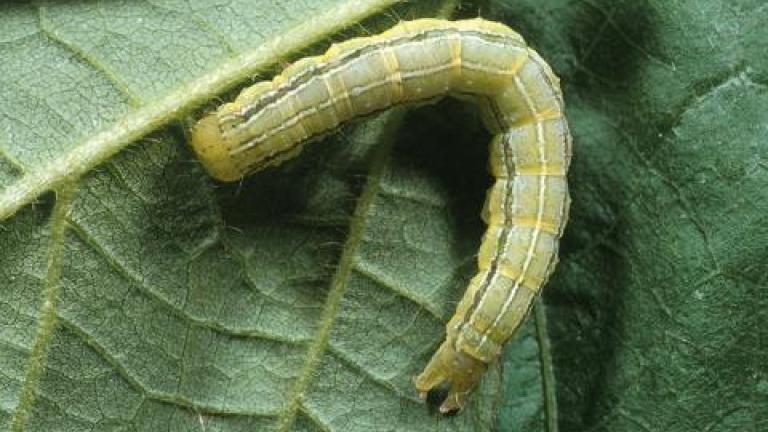
 Anyone who has read The Hungry Caterpillar will remember the insect’s rampage of culinary discovery comes to an end on the seventh day, when he eats a leaf to cure his self-inflicted stomach ache.By this point of the story, he seems to have learnt his lesson and practices restraint. However, readers of this blog working in the ornamental sector will recognise that the likelihood of a caterpillar stopping at just one leaf is slim to none.Eric Carle doesn’t specify what breed of caterpillar his popular book is about but, judging from his green appearance, let’s assume he is a beet army worm. Such chewing pests pose a significant problem for the ornamentals sector as they’re capable of inflicting a huge amount of damage to crops. In comparison to their sucking partners in crime, which prefer to pierce leaves in order to suck out plant fluids, chewing pests bite and chew leaves, stems, buds, flowers and roots. Tell-tale holes in leaves are a trademark, as is discolouration on the foliage or petals, severed…
botrytis

28.10.2025Expert Centre blog

Botrytis tips for early spring crops

Daniel Lightfoot

How do I recognise Botrytis?What are the risk conditions for Botrytis?How do I control botrytis on the nursery? We’ve talked about Botrytis before in these blogs but I make no apology for this quick reminder about a disease that can easily get away from you in the cool, humid conditions likely to prevail in polytunnels and greenhouses from now to the start of spring. It’s really important to stay one step ahead, paying special attention to environmental conditions and regular crop inspections.Crops such as calibrachoa, cyclamen, dahlia, geranium, impatiens, pansy, petunia and primula are among those that are particularly vulnerable; so too are consignments in transit, as they’re likely to be carried in an enclosed humid environment, which can favour the disease, and come under more stress than when on the nursery.Biology and symptomsBotrytis, sometimes called grey mould, has a huge range of hosts and is caused by the fungal pathogen Botrytis cinerea. It spreads by spores in the air or splashed by water…